


⚡️ Product Strategy
🖋️ Case study
Beyond Reading: Tailoring the Learning Experience Based on User Goals
Understanding students’ learning goals to create a more personalised, goal-driven experience — unlocking behavioural insights that shaped the roadmap and in-platform strategy.
Context
We knew students came to Perlego with different goals, but our platform treated all reading sessions the same. Without context, content discovery and engagement felt generic. To address this, we launched an experiment to understand what users were trying to achieve each time they opened a book. Our challenge was to translate those behavioural signals into actionable data that could inform both our product roadmap and in-platform communication.
🕵🏻♀️
My role
I designed and led a recurring survey experiment to uncover students’ goals by session, analysing monthly behavioural trends and synthesising patterns across key personas. I then used these insights to influence feature prioritisation, content discovery, and in-platform messaging — creating a more tailored experience aligned with user intent.
Approach
🧭 User journey mapping
Identifying friction points in the discovery-to-reading journey.
📊 Survey design & experimentation
Created an in-platform survey to capture user goals per reading session (e.g. research a topic, complete assigned reading)
📈 Pattern tracking & analysis
Aggregated results monthly to identify shifts in behaviour and segment user base into four purpose-driven categories.
🔄 Segmentation model
Defined “Researchers”, “Assignees”, “Studiers”, and “Extenders” based on intent and behaviour trends.
🧩 Feature mapping
Analysed tool usage per segment (e.g. Read Aloud, TOC nav, citation tools) to identify value per user group.
💬 In-platform messaging
Designed contextual nudges and feature highlights tailored to each learning goal.
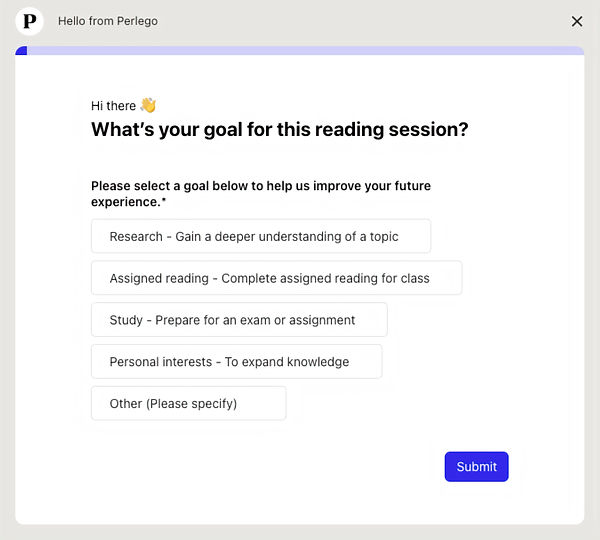
We classified our existing user base in different buckets based on their reading session goals

Understanding the “why” behind each session helped us identify which tools supported each learning goal. For example:
READING SESSION GOAL
Complete assigned reading for class
✏️
Users looking to read to complete an assignment
-
Read Aloud (43%) is the most-used feature — indicating that audio support is critical for users completing class-assigned materials, likely due to multitasking or learning preferences.
-
Low usage of reading accessibility features (16%) and Dark Mode (22%) suggests that visual customisation is less of a priority for this group.
-
Dictionary (13%) is the lowest across all user types, showing they may not be deep-reading for comprehension, but rather scanning for assigned content.
🔍 Insight: Prioritise tools that support passive consumption and reduce friction, especially for compliance-driven use cases.
READING SESSION GOAL
Gain deeper understanding of a topic
🔍
Users looking to read to complete an assignment
-
Strong use of Read Aloud (49%), Font & Size (36%), and Dark Mode (31%) indicates a preference for deep, sustained reading with personalised settings.
-
Dictionary usage (17%) is relatively low for a research-heavy group, suggesting they may rely more on external tools or already have domain familiarity.
🔍 Insight: Researchers use advanced reading tools to create an efficient, distraction-free environment — product improvements should aim at enhancing focus and information structure (e.g. TOC, citations, summaries).
READING SESSION GOAL
Expand their knowledge
🧠
Learners focusing on expanding their knowledge
-
Read Aloud (52%) is the highest of all segments, reinforcing the value of flexible, hands-free learning for this group.
-
High adoption of Dark Mode (39%) and Font & Size controls (40%) indicates a strong need for
personalisation and accessibility.
-
Use of reading accessibility features (29%) suggests they are experimenting with cognitive-enhancing tools.
🔍 Insight: Extenders benefit most from flexibility and control — this segment values comfort, accessibility, and consistent UX across long sessions.
READING SESSION GOAL
Prepare for an exam or an assignment
🎓
Learners focusing on expanding their knowledge
-
Read Aloud (39%) is still a strong preference, useful for reinforcing material in different formats.
-
Dictionary (15%) and reading accessibility tools (15%) are less used, but Dark Mode (27%) and Font & Size (24%) show that basic visual ergonomics matter.
-
This group is likely task-oriented — they want efficient reading with minimal distractions.
🔍 Insight: Studiers benefit from straightforward, supportive tools that help them retain content quickly — improvements should focus on productivity, clarity, and session continuity.
Finally, concluding that researchers were the higher majority of users, which allowed us to make better decisions and define the product roadmap towards improving researchers experience.

Outcomes
-
Captured goals from over 7,000 users monthly, with 30% consistently identifying as Researchers
-
Identified clear behavioural patterns across segments (tool usage, content completion, navigation paths)
-
Rolled out dynamic in-platform messaging tied to learning goals, surfacing the most relevant features for each segment
-
Informed product roadmap — prioritised Read Aloud enhancements, TOC improvements, and offline mode based on segment needs
-
Tracked goal distribution trends across 3+ months to ensure evolving user behaviours continued to shape product thinking
💡
Learnings
This project highlighted the power of asking the right questions early. By embedding a lightweight, recurring survey into the reading flow, we unlocked high-quality behavioural data that revealed students’ real motivations — without disrupting their experience.
It also proved that segmentation isn’t just for marketing — when grounded in user intent, it becomes a strategic tool for product direction. By aligning our roadmap and in-platform messaging with specific goals, we were able to surface value more effectively, improve feature adoption, and create a more meaningful connection between the product and students’ daily study habits.