


⚡️ Product Strategy
🖋️ Case study
Perlego Mobile Strategy
Developing the product strategy for Perlego’s mobile app. Repositioning it as a learning companion — not a secondary product. Defining its unique value and shaping a roadmap that increased weekly reading time by 42%, boosted the iOS App Store rating from 3.7 to 4.5 and Android from 3.2 to 4.0
Context
As Perlego’s mobile usage continued to grow, it became clear that the app had untapped potential beyond simply replicating the web experience. With mobile offering unique behaviours and use cases — particularly for students learning on the go — we saw an opportunity to define a clear product strategy that would reposition the app as a core part of the learning experience. The challenge was to align the team and stakeholders around this new vision, understand how users were engaging with the platform, and shape a roadmap that reflected mobile’s distinct value within the product ecosystem.
🕵🏻♀️
My role
I led the initiative to define the mobile app’s positioning and long-term strategy. I worked across discovery, user research, PMF analysis, stakeholder alignment, and roadmap definition to establish a new vision for mobile — one that recognised its unique value and role in students’ daily lives.
Approach
👀 Competitor analysis
Comparing the app functionality and messaging style with our top competitors.
🔍 Market research
Understanding learning behaviours and different user journeys in the app.
⭐️ Mission statement worksop
Working with the team to form a collective perspective on the app positioning.
💛 Student engagement patterns
Understanding user’s learning patterns and engagement in the app.
💬 User feedback
Analysing and processing user feedback PMF, in-app feedback, app reviews
🎤 User interviews
To validate a few of our assumptions and getting them involved in our discovery process.
⭐️ Personas definition
Defining personas to get a better and cleaner overview of our users in the app.
💫 Strategy alignment
Making sure out mission aligns with our strategy and bigger picture.
📣 Feedback loops and GTM
Establishing and automating feedback loops + defining GTM strategy.
After analysing and combining all of the above, we were able to establish that the app's value proposition audience was for committed learners and defined them as learners that are:
📈
Dedicated to continuous personal, academic and professional development.
🎯
Driven by the passion for acquiring knowledge to achieve their goals.
❤️
Already getting value of their Perlego subscription.
Later, we classified our existing user base in three different buckets based on their usage patterns, learning habits and learning stage
🕵️♀️
Researchers seeking
convenience and flexibility
“I want to take every moment I have to learn and become better in my studies”
Neith, student
👨🎓
Students focused on continuous growth and efficiency
“I am constantly reading books that relate to my subject to learn about my course topics before the uni starts”
Matilda,student
🤵♀️
Individuals that find their purpose in learning
“Every day is a learning day and an opportunity to learn and discover new things. It's also a fulfillment of being a human being”
Jeremy, independent learner
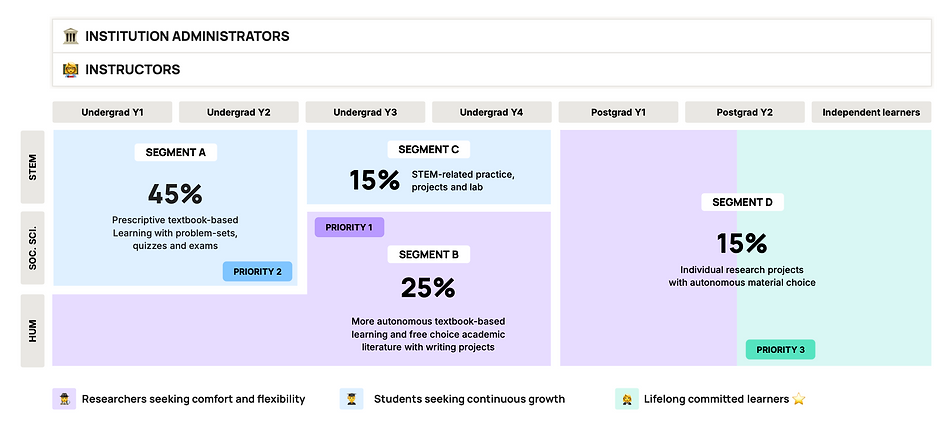
Finally, concluding that the app...
Is not a stand alone product
that serves as a channel for user acquisition
Is not currently a tool that supports deep learning and collaboration
Is a part of the Perlego experience, where committed learners can extend the value of their subscription.
... A tool for convenience, efficiency and flexibility

Understanding user's jobs to be done to create a roadmap that aligns with the app's mission to
✨ Delight and engage committed learners by supporting their study needs ✨
🕺
Flexible learning solutions
They require learning solutions that are flexible, allowing them to study on their own terms and fit learning into their dynamic schedules.
“Mostly because reading is how I want to fill my leisurely hours. If the experience of learning is comfortable it is more enjoyable.”
Meghan, Independent learner
😌
Convenient access from different devices
They require tools and platforms that are compatible across various devices, providing a seamless transition between different learning environments.
“The app is convenient to read before going to bed on the tablet. On the train the phone is very convenient. Same way a slow-cooker is a convenient way to cook"
Roger, Independent learner
⚡️
Efficient
learning tools
They need tools and features that cater to their motivations for productivity and staying ahead in their respective fields.
“Perlego has influenced my learning experience in a way I can access books anywhere . This has broadened my mind”
Francis, Student
👩🚀
Offline access to learning content
They rely on the ability to access learning materials offline is key ensuring continuous access to knowledge.
“Offline is necessary when travelling. Even with a tablet away from your desk, it's useful to have it.”
Roger , Independent learner
📚
Find diverse and relevant content
They need to access diverse and relevant range of academic content that aligns with their goals.
“If there is a question I need to answer, I use the app to find a textbook to find a general understanding of a concept ”
Imahn, student
⭐️
Continuous improvement
They need access to tools and platforms that reflect their commitment to staying relevant and on top of their aspirations.
“Every day is a learning day and an opportunity to learn and discover new things. It's like humans are intended to learn, explore and discover new things”
Jeremy, Independent learner
JTBD
Conduct academic research
within a topic
🕵️♀️
Researchers seeking convenience and flexibility
Students and researchers that value in-depth and advanced exploration of academic content, dedicated to further their studies and develop their knowledge within their field of study.
They use the app to find relevant content and advance in their studies in their free time, offering convenient access to content and enhancing efficiency.
JTBD
Utilise assigned content to meet course requirements
👨🎓
Students focused on continuous growth and efficiency
Students that enjoy delving deep into academic content, value comprehensive resources, and spend dedicated time studying, focused on finding efficient ways to prepare for assignments.
They use the app as a convenient tool that improves the learning experience and is simple and easy to use.
JTBD
Broaden knowledge in a
subject area
🤵♀️
Individuals that find their purpose in learning - lifelong learners
Independent learners that take charge of their learning journey, seek out information on their own, and value self-directed education.
They use the app as a mean to make studies more flexible and practical, specially when offline and away from the desk or working hours.
Task patterns across JTBD
📲 Access
Accessing the content they need at the time they need it.
🔍 Find
Find the books they need on Perlego using the app.
🧐 Evaluate
Assess whether the books they have found are right for them.
🗓️ Organise
Manage their books for now and later.
📝 Consume
Read, listen, understand, take notes.
⭐️ Use
Use their Perlego subscription to help them achieve their study goals
Defining next steps and opportunities for each area, user type and and JBTD

Some of the first steps and taken through experimentation to position the app according to the strategy and mission

Download the app prompt
Increase app awareness on web by propping users that read the top 3 most read topics on the app to download the app and continue learning on the go.
Defined a clear mobile audience and tailored in-app and web messaging accordingly.
Improving offline experience
Changed the app's behaviour to enable users reading offline to access their content instead of providing a negative experience we highlighted offline as a benefit.
Redesigned the offline experience to give priority to already saved content and deliver a positive messaging.


Increasing app adoption with app awareness
A percentage of web only users didn't know about the existence of an app, so every time we identify they where using a mobile browser we prompt them about the app and gave them a link to download the app.
Capturing mobile browsers traffic and redirecting them to use the app instead.
Improving the onboarding experience
We improved the onboarding messaging to make sure we were setting user's expectations around the app's capabilities from the begining (different from the web) highlighting the benefits and differences between book formats (PDF and ePubs), this was informed by user research and feedback provided by users.
From this, we understood that having a clear messaging and right expectations we could engage more with users and align with the app positioning.
Improving app trust and increasing user's confidence by providing better information during onboarding.

Outcomes
-
Delivered a clear, evidence-backed product strategy that repositioned mobile as a companion product, shaping roadmap priorities and influencing company-wide decision-making
-
Improved internal perception and secured continued investment in the mobile team
-
Introduced features aligned with mobile-first behaviours, including text-to-speech, offline reading, and a new onboarding experience
-
Weekly average reading minutes increased by 42% (from 22.4 to 32 mins), indicating deeper mobile engagement
-
Improved app store ratings by 8 points on both iOS and Android within six months
-
Defined a clear mobile audience and tailored in-app and web messaging accordingly
-
Failed download rate dropped by 40%, increasing trust in mobile onboarding and usability
-
Positive sentiment toward the app improved by 14 points, rising from 22% to 36% in a single quarter
💡
Learnings
This project was a turning point. It proved that mobile deserves its own narrative — not as a mirrored version of the web, but as a distinct product shaped by user behaviour and contextual needs.
By clearly framing the value of learning on the go, we shifted internal perception, created clarity for the team, and rebuilt confidence in the product’s potential. Most importantly, we were able to recenter the mobile experience around students’ real lives, making the product feel more relevant and useful — not just smaller.